Vanway Precision Materials Tech Co.,Ltd


How to Choose the Right Aluminum Extrusion Temper?
How to Choose the Right Aluminum Extrusion Temper?
Choosing the right aluminum alloy is only half the battle in manufacturing. To unlock the true potential of an aluminum extrusion, you must select the correct temper (or state).
Aluminum Extrusion Tempers define the mechanical properties of the metal. Manufacturers manipulate these states through heat treatment, strain hardening, or natural aging. Consequently, the same aluminum alloy can behave like a flexible ribbon or a structural beam depending entirely on its temper.
This guide explores the most common aluminum extrusion alloy states, details their ideal applications, and compares their mechanical characteristics.
Related Blogs:
How to choose the correct aluminum extrusion alloy?
How to Choose the Right Deck Railing: Why Aluminum Railings?
Aluminum Extrusion Process – A Guide to its Effective Methods
Measuring the Basics of the Temper Designation System
Before diving into specific applications, engineers must understand what the temper codes mean. The Aluminum Association uses a letter-and-number system to standardize these states globally.
Sketching the Basic Classifications
The industry categorizes aluminum alloys into five basic temper treatments. Each letter represents a fundamental process:
- F (As Fabricated): Applies to products that undergo no special thermal control.
- O (Annealed): Represents the softest state, achieved through controlled heating.
- H (Strain Hardened): Applies to non-heat-treatable alloys that gain strength through cold working.
- W (Solution Heat Treated): An unstable state applicable only to alloys that age spontaneously at room temperature.
- T (Thermally Treated): Applies to heat-treatable alloys to produce stable tempers.
Inking the “T” Temper Breakdown
Because the 6000-series aluminum (e.g., 6061, 6063) dominates the extrusion industry, manufacturers utilize the “T” (Thermally Treated) state more than any other.
The numbers following the “T” indicate specific sequences of quenching, cold working, and aging. For instance, understanding the nuance between a T4, T5, or T6 state allows designers to balance formability against ultimate tensile strength.
Exploring Common Extrusion States and Use Applications:
Different industries demand different material behaviors. While a construction firm might require maximum rigidity, an automotive manufacturer might prioritize energy absorption.
T4 Temper for Maximum Flexibility
Mechanical Characteristics of T4
To achieve the T4 state, manufacturers heat the aluminum alloy to a high temperature, quench it rapidly in water, and then allow it to age naturally at room temperature. This process yields excellent ductility, superior fracture toughness, and moderate strength.
Ideal Application Scenarios for T4
Because T4 aluminum retains high formability, engineers select this state for components requiring heavy post-extrusion forming.
- Automotive Crash Zones: Car manufacturers utilize 6000-series T4 extrusions for frame rails because the metal bends and absorbs impact energy without snapping.
- Complex Architectural Trim: Builders prefer T4 when they need to bend straight profiles into arches or custom curves on-site.
T5 Temper for Seamless Alignment
Mechanical Characteristics of T5
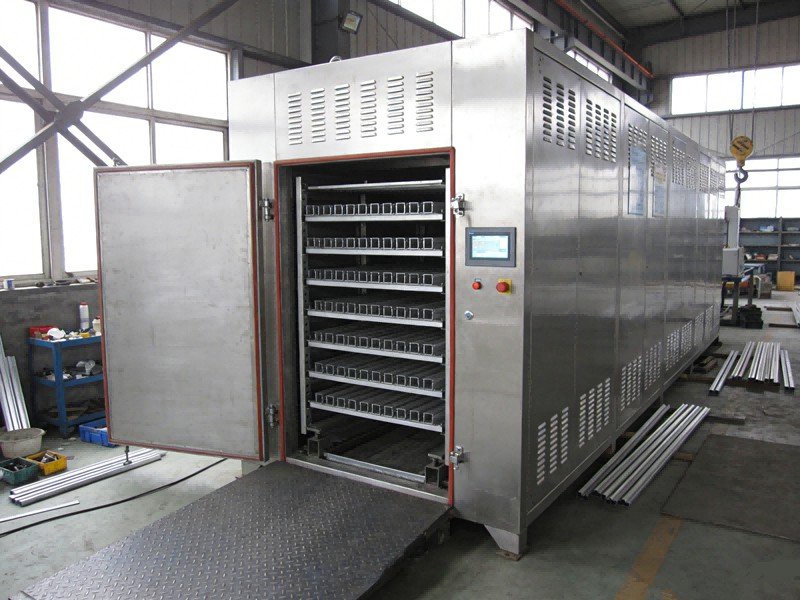
The T5 process bypasses the intensive water-quenching phase. Instead, workers cool the aluminum rapidly with air blasts immediately as it exits the extrusion die. Afterward, the metal undergoes artificial aging in a curing oven. This creates a highly dimensionally stable profile with moderate strength.
Ideal Application Scenarios for T5
T5 is the standard “workhorse” state for architectural applications because the air-cooling process minimizes warping and distortion.
- Window and Door Frames: Companies heavily rely on 6063-T5 for residential window frames because it offers sharp aesthetic lines and sufficient strength for wind loads.
- Curtain Walls: High-rise glass facades utilize T5 profiles to maintain strict tolerances across vast surface areas.
T6 Temper for Heavy-Duty Rigidity
Mechanical Characteristics of T6
The T6 state represents the peak strength configuration for most standard extrusions. Manufacturers combine the rigorous water-quenching of the T4 process with the oven-baking (artificial aging) of the T5 process. This combination maximizes precipitation hardening, which significantly elevates the yield strength.
Ideal Application Scenarios for T6
When a project demands structural integrity and weight-bearing capabilities, T6 is the mandatory choice.
- Structural Frameworks: Aerospace and marine industries implement 6061-T6 for heavy-duty load-bearing frames.
- Bicycle Components: High-end bicycle manufacturers use T6 extrusions for frames and rims to ensure the metal resists bending under high stress.
Technical Comparison of Aluminum Extrusion Tempers
To help you visualize the differences, the table below compares the mechanical properties of the most popular extrusion alloys across different tempers.
| Alloy & Temper | Yield Strength (MPa) | Tensile Strength (MPa) | Elongation (%) | Primary Industry Use |
| 6063-T5 | 145 | 185 | 12 | Windows, Doors, Trim |
| 6063-T6 | 214 | 241 | 12 | Solar Panel Frames, Conduit |
| 6061-T4 | 145 | 241 | 22 | Automotive Parts, Structural Tubes |
| 6061-T6 | 276 | 310 | 12 | Bridges, Marine Rigs, Aerospace |
Navigating the Right State for Your Project
In summary, selecting the correct temper requires a careful balance between your manufacturing process and the final product’s environment. If your design demands severe bending or stamping after extrusion, specify the T4 state. If you require standard architectural shapes with minimal distortion, choose T5. Finally, if your application involves high loads and requires maximum structural rigidity, default to T6.
For deeper technical deep-dives into alloy chemistry and standardization, you can reference the official guidelines provided by the Aluminum Association, explore comprehensive material datasets on MatWeb Aluminum Data, or review international manufacturing standards via the ASM International Materials Information.
Vanway-Tech: Your trusted partner for superior
Aluminum Extrusion Solutions from China.
Vanway Precision Materials Tech Co.,Ltd is a trusted leader in premium aluminum extrusion profiles. It offers custom, industrial, architectural options, angle, channels, tubes and precision extruded products for industrial, infrastructure and downstream sectors.
With years of expertise in aluminium fabrication and extrusion design, we are committed to continuous innovation in custom aluminium profile solutions, delivering reliable OEM & ODM services across the entire aluminium industry. We provide precision anodized and powder coated aluminium extrusions to meet the diverse demands of international clients in construction, renewable energy, automotive, furniture and machinery sectors.
Established in 2015, our advanced production base is equipped with cutting-edge extrusion presses, CNC machining centers and automated production lines, supported by strict quality control systems for dimensional accuracy and durability. This ensures our custom aluminium extrusions feature superior precision and efficiency, ideal for curtain wall frames, door & window systems, industrial assembly lines and infrastructure reinforcements.
Contact Vanway Tech today for tailored one-stop aluminium extrusion solutions.
Contact With Vanway Tech Team for Premium Aluminium Extrusion Products!
Enquire with UsConnect with Vanway Tech Team for Premium Aluminium Extrusion Products.
Contact InfoWe are looking forward to hearing from you!
-
Email: info@vanway-tech.com
-
Address: No. 588, Wuyi South Road, CSJ Moldware Town, Wujin, Changzhou, Jiangsu, China
Scan Below Codes to Contact Us Immediately.